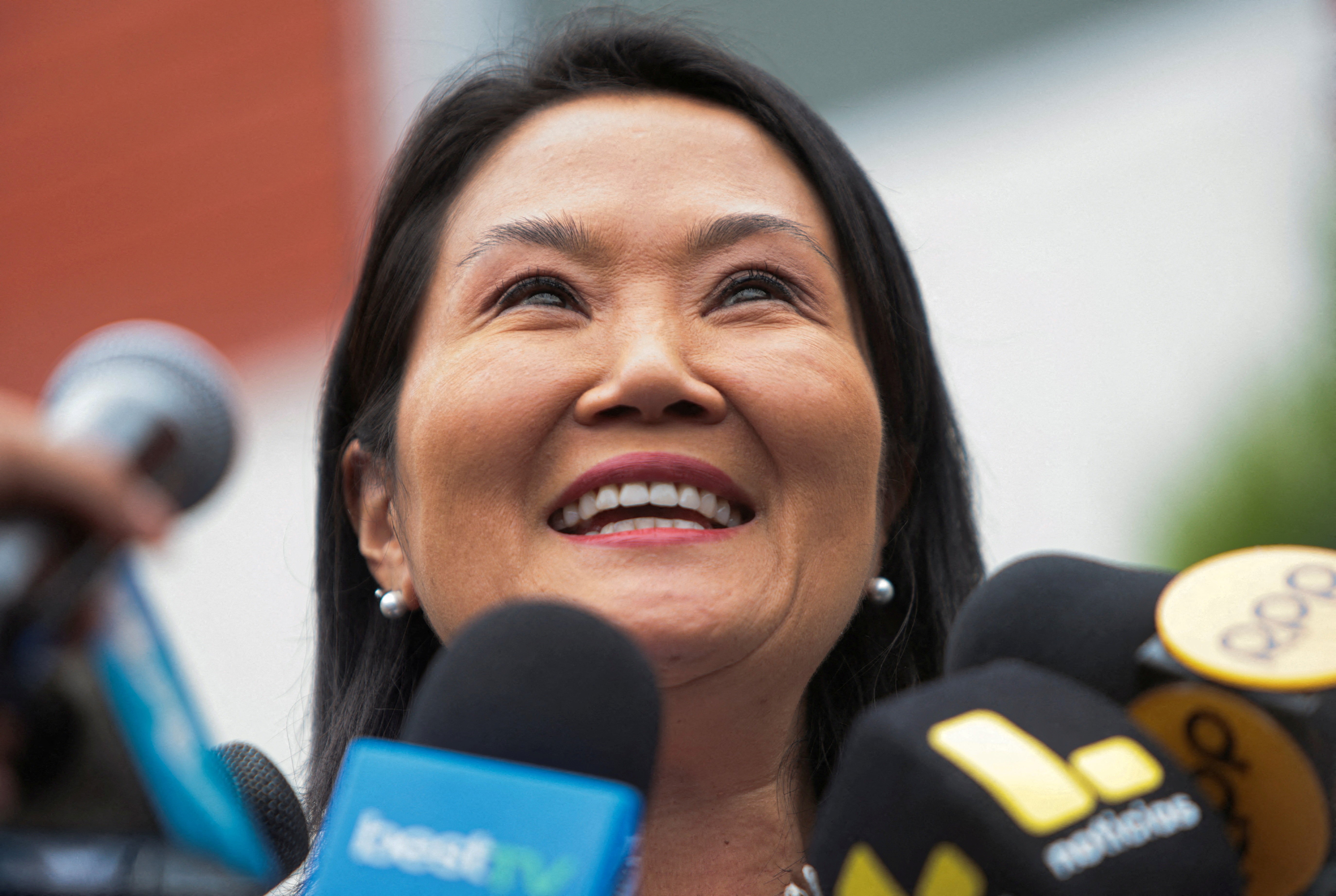
Elections in Peru: Keiko Fujimori achieves irreversible advantage and must be elected The new elected president of Peru, Keiko Fujimori, will assume the leadership of the House of Pizarro, the seat of the country's Executive, after three consecutive electoral defeats. Daughter of former dictator Alberto Fujimori (1938-2024), the leader of the Peruvian right has been an inevitable figure in the political life of the Andean country for more than 20 years, and the heir to a surname that continues to deeply divide the Andean country. ? Follow the g1 international news channel on WhatsApp A defeated candidate in three presidential elections (2011, 2016 and 2021), Keiko seemed doomed to remain the eternal runner-up. His announced victory crowns more than 15 years of attempts to reach the country's top position. According to the country's National Elections Jury (JNE), she beat Roberto Sánchez by a narrow margin: 50.135% to 49.865%. Keiko Fujimori on June 19, 2026 REUTERS/Stifs Paucca/File Photo At 51 years old, Keiko Fujimori has been in politics since she was a teenager. Graduated in business administration in the United States, she was elected to Congress in 2006 with the highest vote ever recorded for a Peruvian parliamentarian. The candidate also spent years under investigation for alleged irregular campaign financing. The case was dropped last year. Between 2018 and 2020, she was detained twice in pre-trial detention and spent almost a year and a half in jail. Keiko has presented herself as the candidate most capable of restoring order and stability in Peru. In the campaign, she explored the context of violence experienced by the country, marked by an increase in homicides and extortion. Voters' concerns about security created a kind of nostalgia for Alberto Fujimori's style of government. In the 1990s, he defeated guerrillas from the Sendero Luminoso group with support from the Armed Forces. In this wave, Keiko promises strict security measures, tougher anti-terrorism laws and an expanded role for the military in combating violence. She claims she will wage a "frontal war" against crime. The tougher speech and alignment with some of his father's ideas were seen as the emergence of a "new Keiko". Still, the party makes a point of differentiating her from Fujimori, presenting her as a more democratic candidate. The new strategy helped Keiko reduce the high rejection rates that marked previous campaigns. According to Ipsos Peru, 40% of voters said before the second round that they would not vote for her at all. The rate is lower than that recorded in the first round, when it reached 59%. One of his first tasks will be to consolidate a solid base in the Legislature. Keiko's Força Popular had 22 senators and 45 deputies. Taking other parties into account, right-wing forces have 30 seats in the Senate and 63 in the Chamber of Deputies. Brand positioning In a Peru that changes leadership frequently, with eight presidents since 2016, Fujimori is perhaps the most consolidated member of the country's politics. His surname resonates in every corner of the Andean country. "It's a 'brand' that is well positioned, whether they like it or not," says political scientist Jorge Aragón. Keiko grew up in the corridors of power and was a figure in her father's government at the age of 19. Alongside him, he interacted with heads of state and international leaders. A central figure in Peruvian politics, Alberto Fujimori governed the country during turbulent times. He defeated the guerrillas of the Maoist group Sendero Luminoso and the Guevaristas of the MRTA, controlled hyperinflation, but was also condemned for corruption and human rights violations, such as the forced tubal ligation of indigenous women. For decades, Keiko has been unable to free herself from the lights and shadows of her surname, which guarantees her contacts and a solid electorate. "I miss him," he said in an interview with AFP on the eve of the election. “But wherever I go, they remind me and tell me stories,” he commented. "In the last 25 years, we have been governed by anti-fujimorist governments", which "dedicated themselves to insulting, generating hatred and division among Peruvians", stated the then candidate. His critics attribute much of Peru's political instability to him, given the strong influence of his Popular Force party - known for forging political alliances in Congress. This was the first election without his father, who died in 2024, but who came to be seen as a symbol of the fight against crime. The former president's daughter promised to mobilize the military for a "war" against groups dedicated to extortion and expel migrants who commit crimes. "I will take the lead to fight criminals," he said recently. 'Blessed daughter' In her close circle, she is described as "perseverant, determined and disciplined". "Every blow she received in life didn't break her; it made her even stronger than anyone could imagine," Miguel Torres, who will be her vice-president, told AFP. She also spent more than a year in pre-trial detention, investigated for alleged money laundering in the Odebrecht corruption scandal, as part of the Lava-Jato operation. Seen as a belligerent politician, Keiko has sought to soften her image and present herself in a more conciliatory manner. "In my political career, I also made mistakes, I learned from them; but I also stood up with much more strength," he said. Keiko is the mother of two young women, one aged 18 and the other aged 16, the result of her marriage to an American man from whom she divorced. Her name in Japanese means "blessed daughter" or "fortunate". She is popularly known as "the Chinese", a nickname she received at school for her slanted eyes. With information from the AFP agency.
/https://i.s3.glbimg.com/v1/AUTH_59edd422c0c84a879bd37670ae4f538a/internal_photos/bs/2026/Z/s/3ooVBsR7mxTMAXsyvTcw/2026-06-24t182421z-1573473901-rc2h0maekzvx-rtrmadp-3-peru-politics-fujimori.jpg)